On this page
- What is a Birth Certificate — And What Changed in 2023
- Three Portals — Which One Has Your Record
- Where You Need a Birth Certificate — 8 Mandatory Uses
- The 21-Day Rule — Registration Timeline
- Documents Required — Hospital vs Home Birth
- How to Apply on eSathi — Step by Step
- Adding the Child's Name After Registration
- 5 Common Rejection Reasons — And How to Avoid Each
- Fee, Validity & Download
- Frequently Asked Questions
- Quick Reference Table
What is a Birth Certificate — And What Changed in 2023
A birth certificate (जन्म प्रमाण पत्र / Janam Praman Patra) is the first official identity document a person receives. It records the child's name, date and time of birth, gender, place of birth, parents' names, and residential address. The Registration of Births and Deaths Act, 1969 (RBD Act) governs birth registration across India, making it mandatory — not optional. For hospital births, the hospital itself reports the birth to the local Registrar. For home births, the family must report to the Gram Panchayat (rural) or municipal office (urban) within 21 days.
In December 2023, the Indian Parliament passed the Registration of Births and Deaths (Amendment) Act, 2023, introducing changes that directly affect how birth certificates work in UP and across India. The amendment mandates that the Registrar must issue a birth certificate within 7 days of completing registration — a legally enforceable timeline that did not exist before. It introduces digital registration options, electronic certificate delivery, and the creation of national and state-level databases that link birth records with Aadhaar, education, and health systems. For delayed registrations, self-attested documents now replace notarized affidavits in many situations, and the authority for late registrations has been standardised to the District Magistrate level. The amendment also mandates collection of Aadhaar details of parents during registration where available (source: CRS Report 2024 / Outlook India, July 2026).
- 1969RBD Act — birth registration made mandatory nationwide
- Dec 2023Amendment Act passed by Parliament
- DigitalOnline registration, electronic certificates, parents’ Aadhaar
- 7 daysRegistrar must issue the certificate after registration
UP's Birth Registration Reality in Numbers
Understanding the scale matters for context. Uttar Pradesh has approximately 6 million pregnancies every year (source: India Health Action Trust / IHAT). According to NFHS-5, the state's institutional delivery rate has improved dramatically — from just 26.2% in NFHS-3 (2005-06) to 67.8% in NFHS-4 (2015-16) to 83.4% in NFHS-5 (2019-21) (source: NFHS-5 factsheet / CEDA Ashoka University). This improvement is significant, but it also means approximately 16.6% of UP births — roughly 1 million babies every year — still happen outside hospitals, primarily in rural areas where documentation is harder to obtain.
UP institutional deliveries
- 26.2%NFHS-3 · 2005-06
- 67.8%NFHS-4 · 2015-16
- 83.4%NFHS-5 · 2019-21
Roughly 1 million UP births a year still happen outside a hospital.
At the national level, India registered 2.55 crore births in 2024, up from 2.52 crore in 2023, achieving a 99.1% birth registration rate (source: CRS Report 2024, released July 2026). The national sex ratio at birth stands at 933 females per 1000 males. Institutional births formed 79.4% of all registered births nationally. UP's institutional delivery rate still trails the national NFHS-5 figure. ASHA (Accredited Social Health Activist) workers are central to closing that gap — they visit pregnant women during the third trimester, counsel them on hospital delivery, and assist with birth registration in rural areas.
Three Portals — Which One Has Your Record
This is the question that confuses the most people. UP has three different online portals for birth certificates, and each one serves a different type of record. Using the wrong portal means spending time searching for a certificate that isn't there.
Which portal has your record?
- Recent hospital birth (2024+)CRScrsorgi.gov.in
- Urban birth under Nagar Nigame-Nagarsewae-nagarsewa.up.gov.in
- Older record, or not foundeSathiesathi.up.gov.in
- CRS Portal (crsorgi.gov.in) — The Civil Registration System, managed by the Registrar General of India. This is becoming the primary national system for birth registration. Use it for recent births (2024 onwards in most UP districts) registered through hospitals, rural health centres, and gram panchayats. Aadhaar linking of parents is mandatory during registration on CRS. You can register a new birth, track the registration status, and download the certificate here.
- e-Nagarsewa Portal (e-nagarsewa.up.gov.in) — For births registered under urban local bodies — Nagar Nigam (Municipal Corporation), Nagar Palika, and Nagar Panchayat. Covers major UP cities including Lucknow, Kanpur, Varanasi, Agra, Prayagraj, Meerut, Ghaziabad, and others. Important: e-Nagarsewa has its own separate citizen login — different from eSathi. You need to register on e-Nagarsewa with your name, father's name, address, mobile number, and email ID before you can search or download. Search by registration number, acknowledgment number, or basic details (city + date of birth).
- eDistrict UP / eSathi (esathi.up.gov.in) — The eDistrict UP portal provides access to older birth records across all 75 districts. Use this when the record is not available on CRS or e-Nagarsewa — typically for births registered before the CRS rollout or for applying for a copy of an already-registered certificate through eSathi. Integrates with DigiLocker (digilocker.gov.in) for digital storage.
Which one should you try first? Recent hospital birth (2024+) → try CRS (crsorgi.gov.in) first. Birth in an urban area (Nagar Nigam city) → try e-Nagarsewa (e-nagarsewa.up.gov.in). Older birth or neither portal shows results → use eSathi (esathi.up.gov.in) through your eDistrict account. Certificates from all three portals are digitally signed under the IT Act, 2000 and include a QR code for verification. Certificates registered after 2015 are also available in DigiLocker under "Issued Documents."
Where You Need a Birth Certificate — 8 Mandatory Uses
- School admission under RTE Act. Under Section 14 of the Right to Education Act, 2009, the birth certificate is the primary document schools use to establish a child's age. Schools in UP ask for it from nursery through higher secondary. But the same section allows other prescribed age documents, and Section 14(2) is explicit: no child shall be denied admission for lack of age proof. Apply for the certificate regardless — board registration, passport and Aadhaar all need it later.
- Passport application. The Passport Seva Kendra requires a birth certificate as proof of date and place of birth for all passport applications. For children under 18, it is the primary identity document. Adult applicants can use alternative age proof, but the birth certificate remains the strongest document.
- Baal Aadhaar for children under 5. UIDAI issues a blue-coloured Aadhaar card for children under 5, called Baal Aadhaar. A birth certificate is the mandatory document for this enrollment. Unlike regular Aadhaar, Baal Aadhaar does not capture biometrics. They must be added later at an enrolment centre — a Mandatory Biometric Update at age 5 and again at 15. It does not happen on its own, and an Aadhaar left without it can be deactivated.
- Age verification. Any situation requiring official age proof — competitive exam eligibility (UPSC, UPPSC, SSC age limits), government job applications, marriage registration (legal age verification), driving license application — can reference the birth certificate as primary proof.
- Government schemes and immunisation. Child welfare schemes, nutrition programmes under ICDS (Integrated Child Development Services), immunisation records, and Anganwadi registration reference the birth certificate. ASHA workers often assist families in obtaining birth certificates as part of their role in connecting rural households to government health services.
- Insurance and financial products. Some insurance policies and child-specific financial products — Sukanya Samriddhi Yojana (for girl children), PPF accounts for minors, child insurance plans — require the birth certificate as proof of the child's identity and age.
- Legal and inheritance matters. In cases of disputed identity, parentage, or inheritance, the birth certificate serves as primary legal evidence of a person's existence, parentage, and date of birth.
- Voter registration at 18. When a young person turns 18 and applies for voter registration, the birth certificate serves as the primary proof of date of birth for establishing eligibility.
The 21-Day Rule — Registration Timeline
The RBD Act, 1969 sets clear timelines for birth registration, and each bracket adds complexity and cost.
- Within 21 days — free registration. Report the birth to the local Registrar. For hospital births, the hospital itself reports to the Registrar — most hospitals in UP now do this electronically through the CRS system. For home births, the family must report to the Gram Panchayat (rural) or municipal office (urban). Registration within 21 days is free. The child's name can be added within 1 year of registration — the initial registration can proceed without a name if the family hasn't decided yet.
- 22 to 30 days — late fee applies. Registration with a nominal late fee of ₹2–50 in UP. No additional documentation is needed beyond the standard documents. The process is the same as within 21 days, just with the fee.
- 31 days to 1 year — written permission required. Registration requires written permission from the District Registrar along with a self-attested document explaining the delay (under the RBD Amendment 2023, self-attestation replaces notarized affidavit for this bracket in many states). The prescribed fee must be paid.
- After 1 year — magistrate's order mandatory. A District Magistrate, SDM, or Executive Magistrate must order the registration. File a petition through a lawyer with supporting documents — hospital records, Anganwadi records, school records showing date of birth, immunisation card, witness affidavits. The magistrate verifies the facts before ordering the Registrar to register the birth. This process takes weeks to months and involves legal costs.
Practical reality: Many parents in rural UP delay registration beyond 21 days due to lack of awareness, distance from the registration office, or because a home birth had no institutional record to trigger automatic registration. If your child's birth was never registered regardless of how long ago it happened, start the process immediately. The RBD Act allows late registration at any time — but the longer you wait, the harder and more expensive it becomes.
Documents Required — Hospital vs Home Birth
The documents differ fundamentally based on where the birth occurred, and in rural UP where approximately 1 million births per year still happen at home, the home birth documentation is equally important to cover.
Hospital / Institutional Births
Hospital Discharge Summary / Birth Report — The primary document. Hospitals issue this at the time of discharge, recording the child's date and time of birth, gender, weight, mother's name, and attending doctor's details. Government hospital reports carry higher weight. Keep the original safe — it is the strongest proof of birth and cannot be replaced easily if lost.
Parents' Aadhaar Card — For identity verification and e-KYC. Under the RBD Amendment 2023, Aadhaar details of parents are collected during registration where available.
Marriage Certificate of Parents — Not mandatory but helpful. Establishes the parents' relationship and strengthens the application, particularly for delayed registrations where additional proof is needed.
Passport Size Photograph — JPEG format, under 50KB.
Home Births (Rural UP)
- Anganwadi Worker's Record — Anganwadi workers maintain birth records in their area as part of ICDS (Integrated Child Development Services). If the birth was attended by or known to the local Anganwadi worker, their record serves as birth proof. In many rural UP villages, the Anganwadi worker is the first government touchpoint for maternal and child health.
- Dai (Midwife) Declaration — If a traditional birth attendant (Dai) assisted with the delivery, their written statement confirming the birth details serves as an official document. This should include the date, time, place, child's gender, and mother's name.
- Gram Pradhan Certificate — The village head issues a certificate confirming that the birth occurred in the village, with the date and parents' details. Issued on the Gram Pradhan's letterhead with signature and seal.
- ASHA Worker Connection — Accredited Social Health Activists (ASHAs) visit pregnant women during the third trimester under the National Health Mission. They counsel on institutional delivery, accompany women to hospitals, and assist with birth registration after delivery. If you had a home birth and lack documentation, your local ASHA worker can help connect you with the Anganwadi worker or Gram Pradhan for the necessary certificate.
- Parents' Aadhaar Cards — For identity verification.
Delayed Registration (After 1 Year)
All the standard documents above, plus: a self-declaration or affidavit explaining why registration was delayed, supporting evidence (school admission records showing date of birth, immunisation card, Anganwadi records), two witness affidavits from people who can confirm the birth, and a magistrate's order directing the Registrar to register the birth. Under the RBD Amendment 2023, self-attested documents can replace notarized affidavits for delayed registration in many situations, reducing the cost and complexity.
All uploaded files must be under 100KB, JPEG or PDF format.
How to Apply on eSathi — Step by Step
This process is for obtaining a birth certificate copy through the eDistrict system or for registrations processed through eSathi. For first-time registration within 21 days, the primary route is the hospital (which reports automatically) or the local Registrar (Gram Panchayat / municipal office).
- Step 1: Log in to eSathi at esathi.up.gov.in.
- Step 2: Select "जन्म प्रमाण पत्र" (Birth Certificate) from available services.
- Step 3: Fill the child's details — name (if named), date of birth, time of birth, gender, place of birth (hospital name and address, or home address for home births).
- Step 4: Fill parents' details — father's name, mother's name, address, occupation. These partially auto-fill from Aadhaar e-KYC.
- Step 5: Indicate whether the birth was in a hospital (Yes/No). If yes, enter the hospital name and upload the hospital birth report.
- Step 6: Upload all required documents. Each file under 100KB, JPEG or PDF.
- Step 7: Pay ₹10–15 via PAYGOV (UPI, net banking, debit card).
- Step 8: Submit and save your Service Request Number (SRN). Track on the status check section of our homepage.
Alternatively, visit any CSC (Jan Seva Kendra). CSC charges ₹30 government fee plus facilitation fee.
Adding the Child's Name After Registration
The RBD Act contains a specific provision that many parents don't know about: you can register the birth within 21 days without deciding on the child's name. The name can be added within 1 year of registration through a separate application to the same Registrar who processed the original registration. This is particularly relevant in families where naming ceremonies happen weeks or months after birth.
If the name was not added within 1 year, or if you need to correct the name later, the process requires an application to the District Registration Office with supporting documents — school records, Aadhaar, an affidavit with the correct name. Online name correction is currently not available in UP through any of the three portals. You must visit the District Registration Office in person for name corrections or additions beyond the 1-year window.
5 Common Rejection Reasons — And How to Avoid Each
- 1. Date of birth mismatch between hospital record and the application form. The system cross-checks the hospital record against the date entered in the form. Even a single day's difference triggers rejection. Copy the exact date and time from the hospital discharge slip — do not enter from memory.
- 2. Parent name spelling different on the form versus Aadhaar. The e-KYC system auto-fills from Aadhaar, but if you manually override with a different spelling — even adding or removing a middle name — it creates a mismatch that the verification officer flags. Use the exact name as printed on your Aadhaar card, including middle names, initials, and language-specific spelling.
- 3. Delayed registration submitted without the required magistrate's order. Births registered after 1 year need a magistrate's order along with supporting affidavits and evidence. Submitting without these results in automatic rejection because the system checks the registration timeline. Follow the delayed registration procedure matching the time elapsed since birth.
- 4. Home birth submitted without any supporting document. No hospital report, no Anganwadi record, no Dai statement — just a claim without documentation. Get a certificate from the Gram Pradhan confirming the birth. Locate the Anganwadi worker who may have records. For very old unregistered births, school records showing date of birth can serve as supporting evidence alongside the magistrate's order.
- 5. Hospital report scan is blurry or unreadable. The verifying officer cannot read the hospital document because it was photographed at an angle in poor lighting or compressed too aggressively. Scan the document in black and white at 200 DPI — not colour, not a phone camera photo at an angle. Check readability after compression and keep it under 100KB.
Fee, Validity & Download
| Detail | Information |
|---|---|
| First copy at time of registration | Free |
| eSathi fee (additional copies) | ₹10–15 |
| CSC fee | ₹30 + facilitation |
| Certificate issuance timeline (RBD Amendment 2023) | 7 days after completing registration |
| eSathi processing | 7–15 working days |
| Validity | Permanent / Lifetime |
| Download from | eSathi dashboard, CRS portal, e-Nagarsewa portal, or DigiLocker |
| Format | Digitally signed PDF with QR code |
| Legal validity | IT Act, 2000 — valid across India |
| UP Civil Registration helpline | 1800-180-5145 |
| eDistrict helpline | 0522-2304706 |
What the birth certificate looks like
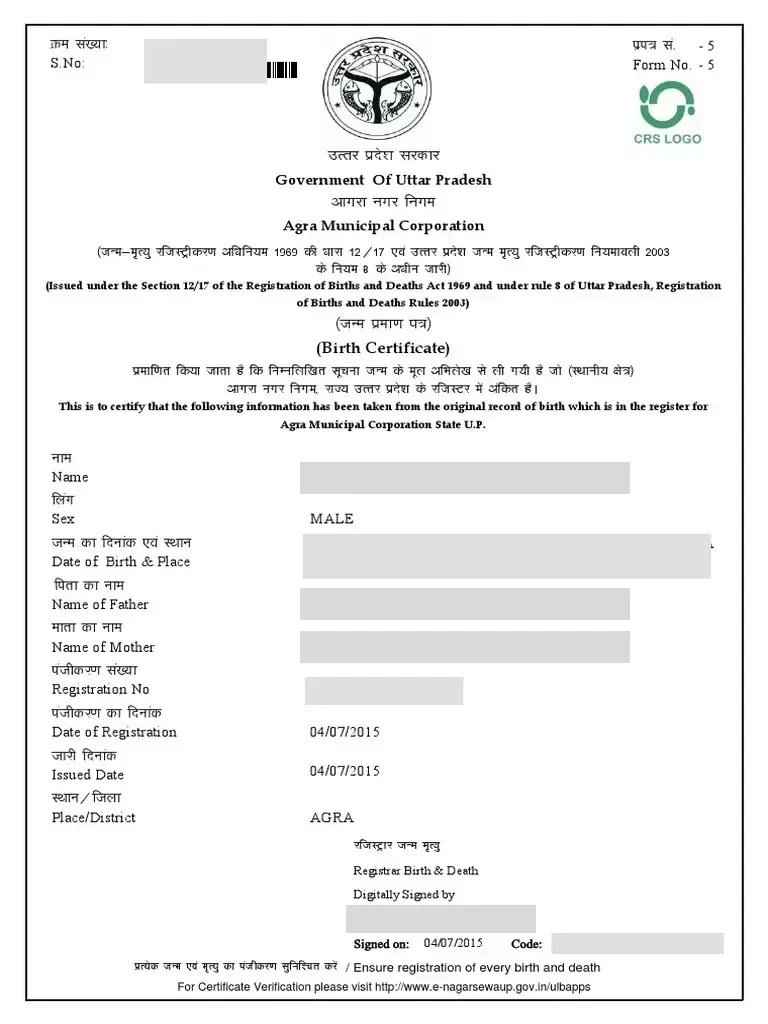
Sample only. All personal details have been removed from this image. A birth certificate can only be issued by the Registrar of Births & Deaths — no website, including this one, can issue, print or supply one.
Certificates registered from 2015 onwards are also available in DigiLocker (digilocker.gov.in) — check under "Issued Documents" → "Birth Certificate." Educational institutions and Passport Seva Kendras accept DigiLocker-linked certificates directly without requiring a physical copy. For step-by-step download instructions, see our certificate download guide on the homepage.
Frequently Asked Questions
Which portal should I use for a UP birth certificate?
It depends on when and where the birth was registered. For recent hospital births from 2024 onwards, try the CRS portal at crsorgi.gov.in first. For births in urban areas under Nagar Nigam or Nagar Palika, use e-Nagarsewa at e-nagarsewa.up.gov.in. For older records or if the other portals don't show results, use eSathi at esathi.up.gov.in through your eDistrict account. All three portals issue legally valid, digitally signed certificates.
#Is a birth certificate mandatory for school admission in UP?
It is the document schools ask for first, but it is not the only one the law allows. Section 14 of the Right to Education Act, 2009 makes the birth certificate the primary proof of a child's age, and schools in UP request it from nursery through higher secondary. The same section also permits other prescribed age documents, and Section 14(2) states that no child shall be denied admission for lack of age proof. If a school refuses admission on that ground alone, raise it with the Block Education Officer. Apply for the certificate anyway — board registration, passport and Aadhaar all need it later.
#My child was born at home in a village. What document replaces the hospital report?
Three alternatives exist for home births in rural UP: an Anganwadi worker's record from the local ICDS centre, a written declaration from the Dai (midwife) who assisted with the delivery, or a certificate from the Gram Pradhan confirming the birth occurred in the village. Any one of these serves as the primary birth proof. Your local ASHA worker can help you connect with the Anganwadi worker or Gram Pradhan if you need assistance obtaining the document.
#My child's birth happened 2 years ago and was never registered. Can I still register?
Yes, but since more than 1 year has passed, you need a magistrate's order. File a petition through a lawyer at the District Magistrate, SDM, or Executive Magistrate's court with supporting documents — hospital records if available, Anganwadi records, school records showing date of birth, immunisation card, and witness affidavits. Under the RBD Amendment Act 2023, self-attested documents can replace notarized affidavits in many delayed registration situations, making the process somewhat easier and cheaper than before.
#Can I register the birth without deciding on the child's name?
Yes. The RBD Act specifically allows birth registration within 21 days without a name. Many families have naming ceremonies weeks or months after birth, and the law accommodates this. The name can be added within 1 year of registration through a separate application to the same Registrar. Don't delay registration just because you haven't chosen a name — the 21-day free window is more valuable than waiting.
#Is the digitally signed birth certificate valid for passport applications?
Yes. The digitally signed PDF with QR code from CRS, e-Nagarsewa, or eSathi is accepted at the Passport Seva Kendra. It is valid under Section 5 of the IT Act, 2000, which makes digitally signed documents legally equivalent to physically signed ones. No additional attestation or notarisation is required.
#How do I correct a wrong name or date of birth on the birth certificate?
Online correction is currently not available in UP through any of the three portals. Visit the District Registration Office in person with an affidavit, supporting documents showing the correct details (school records, Aadhaar), and a written application for correction. The Registrar verifies and issues a corrected certificate. This process can take several weeks depending on the district.
#My child was born in UP but we live in another state. Can we register in UP?
Birth registration happens at the location where the birth occurred, not where the family currently lives. If the birth was in a UP hospital, that hospital's local Registrar handles it — and most hospitals report automatically through the CRS system. If born at home in UP, the local Gram Panchayat or municipal office where the home is located handles registration. You can apply for copies later through eSathi from anywhere.
#What is Baal Aadhaar and do I need a birth certificate for it?
Baal Aadhaar is a blue-coloured Aadhaar card issued by UIDAI for children under 5 years of age. A birth certificate is the mandatory document for Baal Aadhaar enrollment. Unlike regular Aadhaar, Baal Aadhaar does not capture the child's biometrics — those are updated when the child turns 5 (mandatory biometric update) and again at 15. For children aged 5 to 15, the birth certificate serves as proof of identity and date of birth for regular Aadhaar enrollment.
#How much does a birth certificate cost?
The first copy issued at the time of registration is free. Additional copies through eSathi cost ₹10–15. Through a CSC (Jan Seva Kendra), the government fee is ₹30 plus the operator's facilitation fee of ₹30–50. Under the RBD Amendment 2023, the Registrar is mandated to issue the certificate within 7 days of completing registration.
#No matching questions.
Quick Reference Table
| Detail | Information |
|---|---|
| Certificate name (Hindi) | जन्म प्रमाण पत्र (Janam Praman Patra) |
| Governing law | Registration of Births and Deaths Act, 1969 (amended 2023) |
| Issuing authority | Registrar of Births & Deaths (Municipal / Panchayat) |
| Portals | crsorgi.gov.in (CRS) · e-nagarsewa.up.gov.in · esathi.up.gov.in |
| First copy at registration | Free |
| eSathi fee | ₹10–15 |
| CSC fee | ₹30 + facilitation |
| Certificate issuance (RBD Amendment) | 7 days after completing registration |
| eSathi processing | 7–15 working days |
| Validity | Permanent / Lifetime |
| Registration deadline | 21 days (free) · 22–30 (late fee) · 31 days–1 year (permission) · >1 year (magistrate) |
| Name addition | Within 1 year of registration |
| Name correction | District Registration Office (in person — online not available) |
| UP institutional delivery rate | 83.4% (NFHS-5, 2019-21) |
| UP pregnancies per year | ~6 million (source: IHAT) |
| India births registered 2024 | 2.55 crore, 99.1% rate (source: CRS Report 2024) |
| File size limit | 100KB, JPEG or PDF |
| UP Civil Registration helpline | 1800-180-5145 |
| eDistrict helpline | 0522-2304706 |